
WELCOME BONUS 300%
UP TO €2000 + 100
FREE SPINS
UP TO €2000 + 100
FREE SPINS
Home → Blackjack
Blackjack at Goatz Casino: Variants, Rules and Payouts
Side Bets Raise the House Edge to 5%
At the live table, Infinite Blackjack from Evolution carries four separate side bets: Any Pair, 21+3, Hot 3 and Bust It. These wagers sit alongside the main hand rather than replacing it, and each one is settled on its own outcome. The main game keeps an RTP of 99.47%, so the base bet is where the value sits.
The insurance side bet is the clearest example of what an additional wager costs. Insurance pays 2:1 when the dealer holds a ten in the hole, but it returns only 92.53% over time, which leaves a house edge of 7.47%. A player staking €10 on insurance every round gives up about €0.75 per €10 wagered on average, while the main hand at 99.47% gives up roughly €0.05.
Because the side bet is optional, the blended edge depends on how often it is taken. A player who adds a €5 insurance bet to a €10 main bet on every dealer ace is mixing two very different returns: 99.47% on the hand and 92.53% on the side wager. Declining the side bet keeps the blended figure at the main-game level.
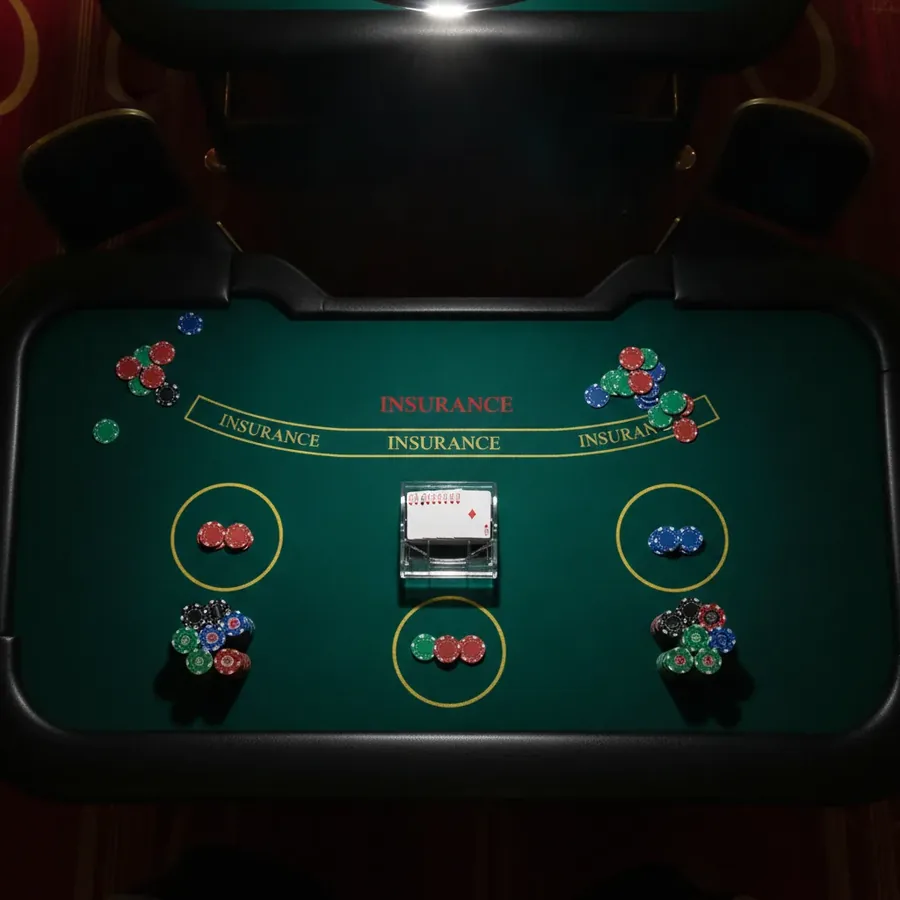
Blackjack Party Has Two Hosts
Blackjack Party is an Evolution live table presented by two hosts, with a bet range of 1.00 € - 1,000 EUR. The format keeps the standard blackjack rules underneath and adds a studio presentation layer on top. The stake range starts at 1.00 €, so the minimum outlay is one euro per round.
Compared with Infinite Blackjack, which accepts 1 € - 5,000 EUR, Blackjack Party caps the upper end at 1,000 EUR. A player staking the 1,000 EUR maximum on Blackjack Party is wagering five times less than the 5,000 EUR ceiling available on Infinite Blackjack. The lower bound is identical at 1 €, so entry cost does not separate the two tables.
Two hosts do not change the underlying mathematics. The main-game return on the Evolution live blackjack tables sits at 99.47% on Infinite Blackjack and 99.56% on Lightning Blackjack, and the presentation format is separate from those figures. A player choosing between the two formats is choosing a stake ceiling, not a different edge.
What a Natural Blackjack Actually Pays
A natural blackjack pays 3:2 under standard rules, which means a 100 EUR stake returns 150 EUR in winnings. Under a 6:5 payout the same hand returns only 120 EUR. The 30 EUR difference on a 100 EUR bet is the single most expensive rule change on the table.
Converting the gap into house edge makes the scale clear. Replacing 3:2 with 6:5 adds exactly 1.39 percentage points to the casino's edge, moving the game from 99.54% RTP to 98.15%. That is a swing of more than any other single rule on the list, including the 0.22 percentage points charged for a dealer who hits soft 17.
On a 10 EUR bet the natural pays 15 EUR at 3:2 and 12 EUR at 6:5, a shortfall of 3 EUR per blackjack. Across ten naturals that is 30 EUR handed back to the house. A player should check the payout line before sitting down, because a 6:5 table cannot be repaired by any other rule.
Split, Double Down and Surrender by the Numbers
Splitting allows up to four hands, and split aces usually receive one card each. Doubling down doubles the stake in exchange for exactly one additional card. Each of these options carries a measurable value: doubling after a split improves the return by about 0.14 percentage points, while resplitting aces adds 0.08 percentage points.
Surrender is a separate rule with its own price. Late surrender lets the player give up the hand after the dealer has checked for blackjack and lose half the stake, which improves RTP by about 0.08 percentage points and returns 50% of the stake. Early surrender is worth up to 0.6 percentage points but is extremely rare, so the late version is what most players will actually meet.
The deck count also shifts the figure. Moving from eight decks to six decks is worth about 0.02 percentage points, and a single deck gives about 0.48 percentage points compared with eight decks. A liberal Vegas Strip rule set combining S17, DAS, resplitting and late surrender reaches 99.72% RTP with a 0.28% house edge and a standard deviation of 1.15.
The Insurance Mistake: 7% Extra House Edge
Insurance is a side bet of up to 50% of the main bet, offered when the dealer shows an ace, and it pays 2:1. Over six to eight decks it returns 92.53%, which leaves a house edge of 7.47%. That is the highest edge figure attached to any blackjack wager on the table.
The contrast with the main game is stark. A six-deck game with S17, DAS, DOA and a 3:2 payout returns 99.54% under basic strategy, an edge of 0.46%. Insurance at 7.47% charges roughly sixteen times as much per euro staked. On 100 EUR of insurance bets the average cost is about 7.47 EUR, against about 0.46 EUR on the same amount in main-hand wagers.
The single-deck version is less punishing at roughly 5.88%, but it still sits far above any main-game figure. Basic strategy always declines insurance, with the exception of card counters at a true count of +3 or higher. For a player who is not counting, taking insurance adds a 7.47% edge on top of an otherwise 0.46% game.
Blackjack variants at a glance
| Variant | Payout | House edge | Rule | RTP |
|---|---|---|---|---|
| Blackjack Liberal Vegas Strip (liberal rules, 3:2) | Blackjack 3:2, win 1:1 | 0.28% | The most player-friendly rule set: S17 + DAS + resplit + late surrender. Standard deviation 1.15 | 99.72% |
| Blackjack Single deck, classic rules, 3:2 | Blackjack 3:2, win 1:1 | 0.15% | Fewer decks = lower edge; one deck gives about −0.48 percentage points compared with 8 decks. Often offset by a 6:5 payout. | 99.85% |
| Blackjack Insurance (6–8 decks) | Insurance 2:1 | 7.47% | Separate side bet of up to 50% of the main bet when the dealer shows an ace. Basic strategy ALWAYS declines it (except for card counters at a true count ≥ +3). With a single deck the edge is ≈ 5.88% | 92.53% |
| Blackjack Surrender (late surrender) – rule effect | 50% of the stake returned | −0.08 percentage points | The player gives up the hand after the dealer has checked for blackjack and loses half the stake. Improves RTP by about 0.08 percentage points. Early surrender is worth much more (up to −0.6 percentage points) but is extremely rare. | n/a (rule modifier) |
| Blackjack Split / double / H17 – rule effects | Double – stake ×2 with one card; split – up to 4 hands; split aces usually get one card each. | H17 +0.22 percentage points; RSA −0.08 percentage points; DAS −0.14 percentage points | Dealer hitting soft 17 lowers RTP by 0.22 percentage points; resplitting aces improves it by 0.08 percentage points; doubling after a split improves it by about 0.14 percentage points; 6 decks instead of 8 – about 0.02 percentage points. | n/a (rule modifiers) |
| Blackjack 6 decks, S17, DAS, DOA, 3:2 payout, basic strategy | Blackjack 3:2, regular win 1:1, insurance 2:1 | 0.46% | Dealer stands on soft 17; double down on any first two cards; doubling after a split allowed; no surrender. Basic strategy is required to reach this figure | 99.54% |
Split Aces: Only One Card per Hand
In Blackjack 6 decks, S17, DAS, DOA with a 3:2 payout, splitting aces normally gives one card to each hand, and that single-card rule keeps the RTP at 99.54% with a house edge of 0.46%. Resplitting aces improves the return by 0.08 percentage points, a small but real gain over the standard one-card treatment. On a €10 stake, that 0.08 percentage point difference is worth about €0.008 per hand, which adds up over hundreds of rounds.
Compare that with Blackjack Single deck, classic rules, 3:2, where the RTP reaches 99.85% and the house edge falls to 0.15%. The one-card-per-ace rule still applies there, yet the single-deck format alone is worth about 0.48 percentage points against an 8-deck shoe. For a player staking €100 across 100 hands, the difference between 99.85% and 99.54% is roughly €0.31 in expected return.
Blackjack Liberal Vegas Strip pushes the RTP to 99.72% with a house edge of 0.28%, using S17, DAS, resplit and late surrender. Late surrender alone is worth 0.08 percentage points, the same size as the resplit-aces gain. A player who splits aces and then doubles after a split is combining two rule effects, DAS at 0.14 percentage points and RSA at 0.08, for a combined edge reduction of 0.22 percentage points.
Doubling After a Split: Which Tables Allow It
Doubling after a split, known as DAS, lowers the house edge by 0.14 percentage points, and the Blackjack 6 decks, S17, DAS, DOA, 3:2 payout, basic strategy table includes it, reaching an RTP of 99.54% and a house edge of 0.46%. Without DAS, that same rule set would sit about 0.14 percentage points worse. On €100 of stakes, DAS saves roughly €0.14 in expected loss.
At the live tables, Infinite Blackjack from Evolution offers an RTP of 99.47% with a bet range of 1 EUR - 5,000 EUR, and Lightning Blackjack from Evolution reaches 99.56% with a bet range of 1 EUR - 2,500 EUR. The gap between Infinite Blackjack at 99.47% and Lightning Blackjack at 99.56% is 0.09 percentage points, so a €1,000 stake returns about €9 more on the Lightning table in theory.
Blackjack Party from Evolution carries a bet range of 1.00 EUR - 1,000 EUR and is hosted by two presenters, while the dealer stands on soft 17 in the S17 format. Dealer hits soft 17, or H17, costs 0.22 percentage points, which is larger than the DAS gain of 0.14 percentage points. A player who picks an S17 table with DAS is therefore better off by a combined 0.36 percentage points against an H17 table without DAS.
Splitting at a Live Table, Step by Step
A split divides a pair into up to 4 hands, and each split hand needs its own stake, so a €10 initial bet on a pair becomes €20, €30 or €40 at risk depending on how many times the hand is split. Doubling down doubles the stake on one hand with a single card. At Lightning Blackjack from Evolution, the bet range runs from 1 EUR to 2,500 EUR, so a four-hand split at the top of that range would commit 10,000 EUR.
Infinite Blackjack from Evolution offers unlimited seats and four side bets: Any Pair, 21+3, Hot 3 and Bust It, with an RTP of 99.47%. Insurance is a separate side bet of up to 50% of the main bet, pays 2:1, and carries a house edge of 7.47% with an RTP of 92.53%. Basic strategy always declines insurance, so a €10 main bet saves the €5 insurance stake on every dealer ace.
Blackjack Party from Evolution has a bet range of 1.00 EUR - 1,000 EUR and uses two hosts, and the standard 3:2 payout applies to a blackjack. A 3:2 payout on a €10 bet returns €15, while 6:5 returns only €12, a difference of €3 per blackjack. Replacing 3:2 with 6:5 adds 1.39 percentage points to the house edge, the largest single rule change on the table.
Stand-on-17 Rule and Its Meaning for Players
Dealer stands on soft 17, written S17, is the rule in the Blackjack 6 decks, S17, DAS, DOA, 3:2 payout, basic strategy table, which reaches an RTP of 99.54% and a house edge of 0.46%. Dealer hits soft 17, written H17, lowers the RTP by 0.22 percentage points instead. On €100 of stakes, the H17 rule costs the player about €0.22 more in expected loss than S17.
Blackjack Liberal Vegas Strip combines S17 with DAS, resplit and late surrender and lifts the RTP to 99.72% with a house edge of 0.28%. Late surrender alone is worth 0.08 percentage points, and DAS adds another 0.14, so the two rules together account for 0.22 percentage points of the improvement over a plain S17 game. A player staking €1,000 across a session saves roughly €2.20 from those two rules combined.
Blackjack Single deck, classic rules, 3:2 reaches an RTP of 99.85% and a house edge of just 0.15%, the lowest edge among the listed variants. Fewer decks help: one deck is about 0.48 percentage points better than eight decks, and six decks instead of eight is worth about 0.02 percentage points. A €10 bet on the single-deck table loses about €0.015 per hand on average, against €0.046 on the six-deck S17 table.
How many decks are in the shoe?
The standard shoe in the Blackjack 6 decks, S17, DAS, DOA, 3:2 payout, basic strategy game holds six decks, and that format produces an RTP of 99.54% with a house edge of 0.46%. Six decks instead of eight is worth about 0.02 percentage points, a small gain compared with the deck effect of a single-deck game. On €1,000 of stakes, the six-deck versus eight-deck gap is about €0.20.
Blackjack Single deck, classic rules, 3:2 reaches an RTP of 99.85% and a house edge of 0.15%, and one deck is about 0.48 percentage points better than eight decks. That 0.48 point gap is far larger than the 0.02 point gap between six and eight decks, so the deck count matters most at the low end. A €10 bet on a single-deck table loses about €0.015 per hand, against €0.046 on a six-deck table.
Blackjack 6:5 payout instead of 3:2 uses six decks and carries an RTP of 98.15% with a house edge of 1.85%. The 6:5 payout adds 1.39 percentage points to the casino edge, which dwarfs the 0.48 point single-deck advantage. A €10 blackjack pays €12 at 6:5 instead of €15 at 3:2, so the deck count becomes secondary when the payout is reduced.
Continuous Shuffling Machines Reshuffle After Every Round
A continuous shuffling machine returns every card to the shoe immediately after each round, so the composition of the deck is reset before the next hand rather than after a full shoe has been dealt. On a six-deck blackjack game with the stand-on-soft-17 rule set, the house edge is 0.46% and the RTP is 99.54%. Because no cut card interrupts play, the number of rounds per hour rises, which means the 0.46% edge is applied more often to the same bankroll.
The effect on a staking plan is straightforward: at 0.46% house edge, 100 EUR of stakes costs about 0.46 EUR on average, while the same 100 EUR on single-deck classic rules at 0.15% house edge costs 0.15 EUR. That is a difference of 0.31 EUR per 100 EUR staked, or roughly 0.31 percentage points of extra casino margin on every euro wagered. The machine does not change the payout on a blackjack: 3:2 still pays 150 EUR on a 100 EUR stake.
For a beginner the practical consequence is that the shoe never reaches the depleted state that card counters look for, so counting systems lose their edge. Doubling down on any first two cards and doubling after a split remain available in the 6-decks, S17, DAS, DOA structure, but resplitting aces and late surrender are not part of that rule set. The 0.46% figure therefore holds only when basic strategy is followed on every hand.
When Can You Raise Your Bet?
In blackjack, increasing the stake beyond the original wager happens through doubling down, where the player adds a second bet equal to the first and receives exactly one more card. Doubling after a split improves the return by about 0.14 percentage points, while the dealer hitting soft 17 lowers it by 0.22 percentage points. On a 10 EUR hand, a double puts 20 EUR at risk on a single card.
A second route is splitting: when the first two cards form a pair, the hand can be divided into up to 4 hands, each with its own stake. Resplitting aces improves the return by 0.08 percentage points, and split aces usually receive one card each, so no further doubling is possible on those hands. The total exposure can therefore reach four times the original bet before any card is drawn.
Late surrender works in the opposite direction: the player gives up the hand after the dealer has checked for blackjack and loses half the stake, which improves the RTP by about 0.08 percentage points. On a 100 EUR bet that is a 50 EUR loss instead of a full 100 EUR. Early surrender would be worth up to 0.6 percentage points more but is extremely rare. Doubling and splitting raise the stake; surrender caps the loss.
Infinite Blackjack vs the Classic Seven-Seat Table
Infinite Blackjack from Evolution removes the seat limit entirely and runs with an RTP of 99.47%, against 99.54% for the six-deck, stand-on-soft-17, double-after-split, double-on-any-cards basic-strategy game. The gap is 0.07 percentage points in favour of the classic structure, which on 100 EUR of stakes is about 0.07 EUR. Unlimited seats mean no waiting list between rounds.
The bet range on Infinite Blackjack runs from 1 EUR to 5,000 EUR and carries four side bets: Any Pair, 21+3, Hot 3 and Bust It. Blackjack Party from Evolution, by contrast, uses two hosts and a bet range of 1.00 EUR to 1,000 EUR, so its maximum stake is one fifth of the Infinite table's. Lightning Blackjack from Evolution sits between them at 1 EUR to 2,500 EUR with an RTP of 99.56%.
The rule that punishes a beginner hardest is the payout on a natural: replacing 3:2 with 6:5 adds exactly 1.39 percentage points to the casino's edge on a six-deck game, taking the RTP to 98.15% and the house edge to 1.85%. On a 10 EUR bet a blackjack then pays 12 EUR instead of 15 EUR. A classic seven-seat table with 3:2 and the 0.46% edge therefore costs less per hand than any 6:5 alternative.
Stop the Session After a 30 Percent Loss
A stop-loss set at 30 percent of the session bankroll means that a 200 EUR bankroll is abandoned once 60 EUR has been lost. At the 0.46% house edge of the six-deck, stand-on-soft-17, double-after-split game, 60 EUR of expected loss corresponds to roughly 13,000 EUR of total stakes, far more than a single session reaches. The limit therefore bites on variance, not on the edge itself.
The comparison with a weaker rule set shows why the threshold matters: at the 1.85% house edge of a 6:5 six-deck game, the same 60 EUR of expected loss arrives after only about 3,200 EUR of stakes. That is roughly four times fewer hands before the stop is triggered. On a 10 EUR base bet the 6:5 table burns through the 30 percent allowance far faster than the 0.46% table.
Insurance is the single bet that most quickly pushes a session toward the stop: it carries an RTP of 92.53% and a house edge of 7.47% on six to eight decks, and basic strategy always declines it except for card counters at a true count of at least +3. On a 5 EUR insurance side bet the expected cost is about 0.37 EUR per decision. A 30 percent stop is reached sooner when insurance is taken repeatedly.
RNG Deals From a Virtual Eight-Deck Shoe
A random number generator that draws from a virtual eight-deck shoe reproduces the composition of 416 cards without a physical shoe, and the deck count itself moves the house edge. One deck instead of eight is worth about 0.48 percentage points in the player's favour on classic rules, where the single-deck RTP is 99.85% and the house edge is 0.15%. Six decks instead of eight is worth about 0.02 percentage points.
The virtual shoe does not remove the payout trap: a 6:5 payout on a six-deck game takes the RTP down to 98.15% and the house edge up to 1.85%, which is 1.39 percentage points worse than 3:2. Liberal Vegas Strip rules with 3:2, stand-on-soft-17, double-after-split, resplit and late surrender reach an RTP of 99.72% and a house edge of 0.28%, with a standard deviation of 1.15. The RNG only shuffles; the rule set sets the price.
For a beginner the relevant number is the long-run average: an RTP of 99.85% on single deck means that over hundreds of thousands of hands the casino keeps 0.15% of all stakes, so 100 EUR of stakes costs about 0.15 EUR on average. RTP is a theoretical long-run figure, not a forecast for one session, and an eight-deck RNG shoe with 6:5 pays 120 EUR on a 100 EUR blackjack instead of 150 EUR.
Contact
Live - online chat
Banking









Providers












Goatz Casino 2026